![owl-Logo-1.png]](https://help.lendingwise.com/hs-fs/hubfs/owl-Logo-1.png?width=43&height=46&name=owl-Logo-1.png)
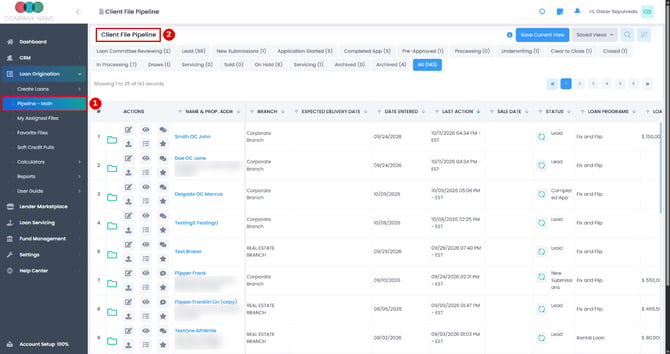
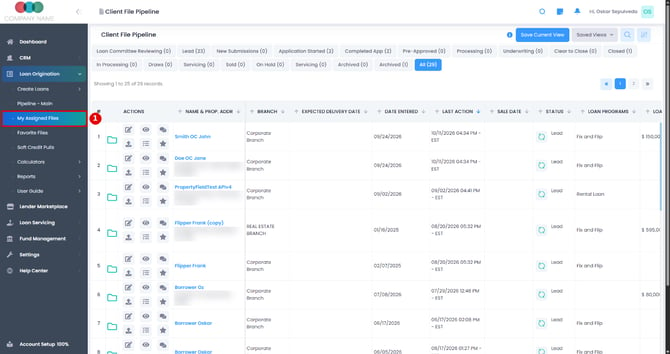
The Pipeline is your main workspace for loan files. It groups files by status and lets you filter, sort, pick columns, save views and export. Go to Loan Origination > Pipeline - Main. The page heading is Client File Pipeline.
Watch: Find any loan file in your Pipeline in about 3 minutes
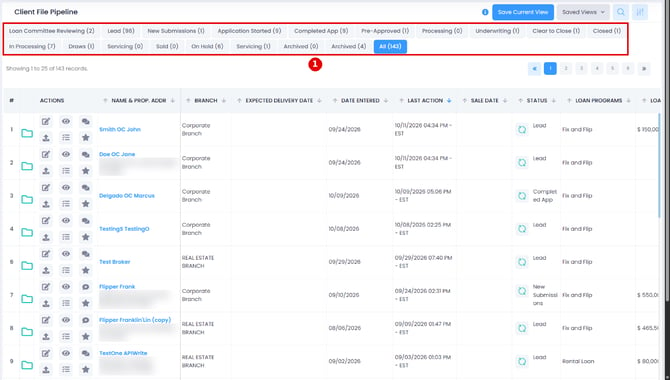
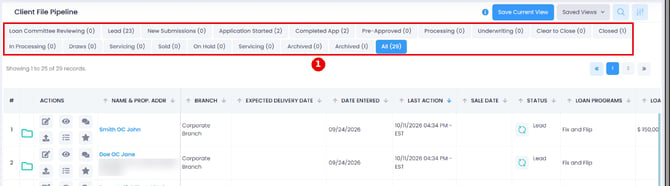
Status tabs
Across the top there's a tab for each Primary File Status (Lead, Processing, Underwriting, Closed and so on), with the number of files in brackets. Draws and Servicing are statuses too. Click a tab to show only those files, or click All to see every file.
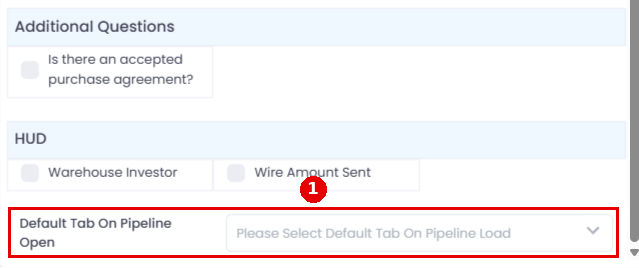
Default tab: instead of opening on All, you can pick which status tab opens when you go to the Pipeline.
Choosing columns
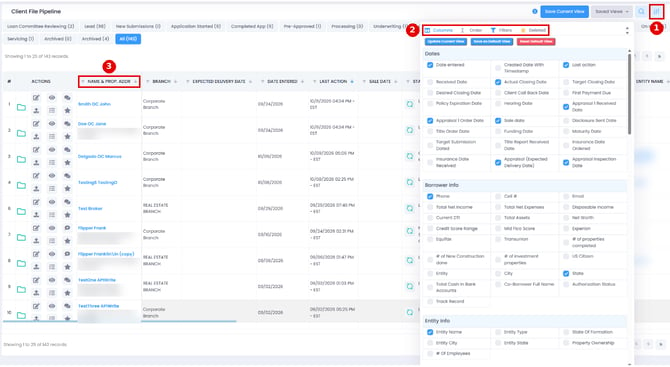
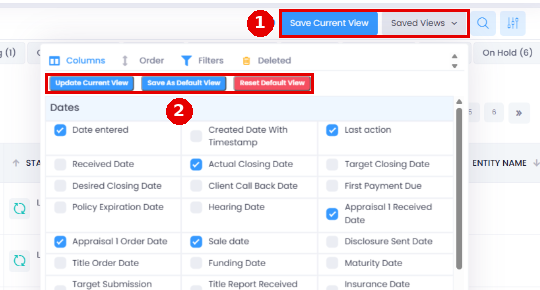
Click the sliders icon at the top right (to the right of the magnifying glass). A window opens with four tabs:
- Columns: tick fields on or off to choose which columns show. Fields are grouped by category, such as Dates, Borrower Info, Entity Info, Loan Info, Property Info and Admin/Staff Details.
- Order: change the left-to-right order of the columns. Handy for matching a loan tape or investor template before you export.
- Filters: choose which search boxes show in Advanced Search. There's no filter row under the column headers.
- Deleted: see and restore deleted views (see "Saved views" below).
Click any column header to sort by it. Click once for ascending and again for descending.
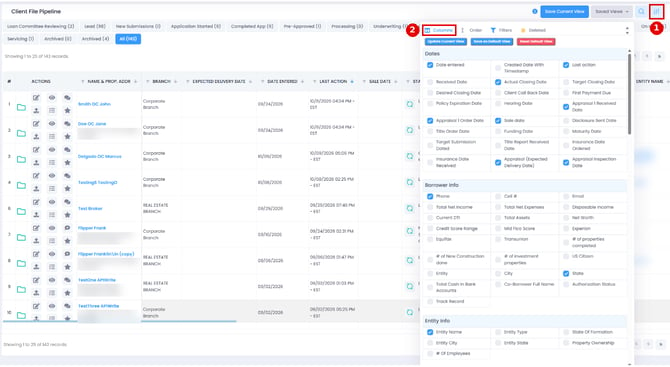
Track how long a file has sat in a status
- Click the sliders icon and open the Columns tab.
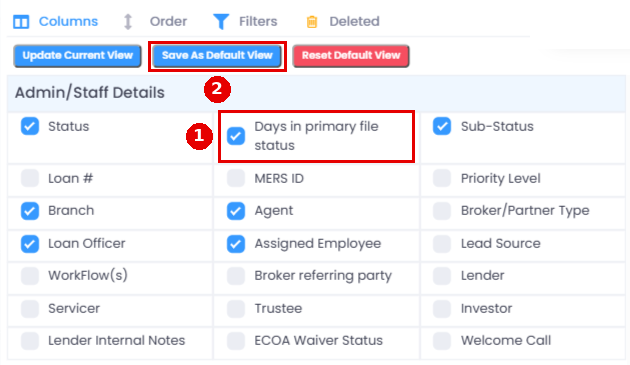
- Tick "Days in Primary file status", then click the blue Save As Default View button.
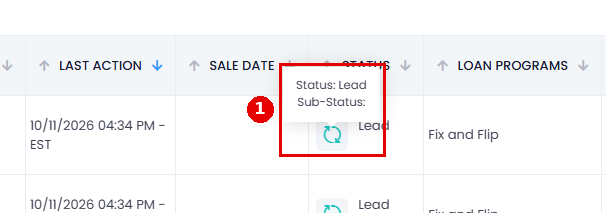
- Hover the icon next to a file's status to see its current Status and Sub-Status.
Saved views
Watch this part of the video: Update, save or reset your view (2:10)
A view saves your filters, columns and sort order so you can switch between setups in one click. Each user manages their own views.
- Save a view: click Save Current View at the top right and give it a name. Views are private by default.
- Share a view: when you save, choose who can see it: just you, everyone, or specific roles such as Processors, Underwriters or Managers.
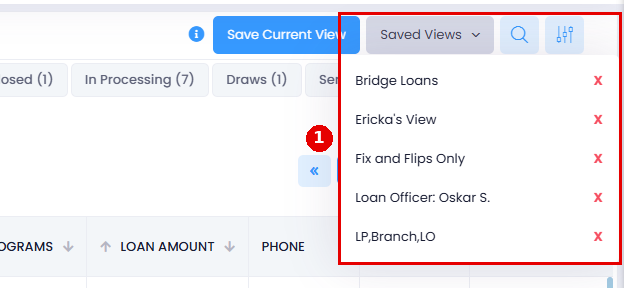
- Open a view: pick it from the Saved Views list next to Save Current View. The list is grouped by the person who made each view, in alphabetical order.
- Delete a view: click the X next to it in Saved Views. You can delete views you made. Managers can also delete other users' views.
- Restore a view (Managers): click the sliders icon and open the Deleted tab. Nothing is gone for good unless a Manager removes it permanently.
The sliders window also has three buttons:
- Update Current View: saves your changes over the view that's open.
- Save As Default View: makes your current setup the one that loads every time you open the Pipeline.
- Reset Default View (red): goes back to the LendingWise default columns and filters.
Advanced Search
Watch this part of the video: Advanced Search (1:03)
Click the magnifying glass at the top right to open Advanced Search. Filters include Branch, Broker, Loan Officer, Assigned Employee, Lead Source, Referring Party, Loan Programs, Internal Loan Programs, Primary Status, Sub-Status, Servicing Status, Property State, File Type, Active/Inactive Files, Client Billing, File Idle (days since last activity), Notes Type, Priority, Payment Based, Workflow Steps (completed and not completed) and more. Date ranges are available for File Created, File Modified, Closing Date, Maturity Date, Appraisal Order Date, Received Date and Disclosure Sent Date.
Click Search to apply the filters and Reset to clear them. To build reports and export, see Filtering, Searching, Creating Custom Reports, and Exporting Data in the Pipeline View.
The ACTIONS column
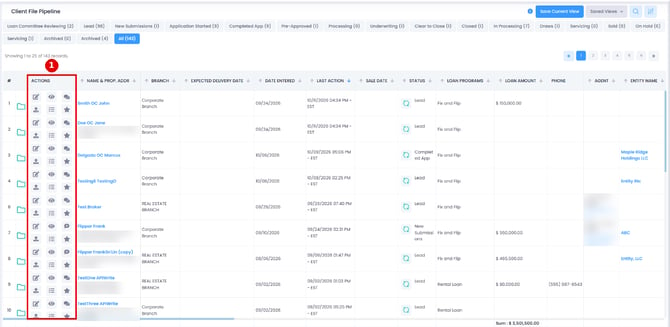
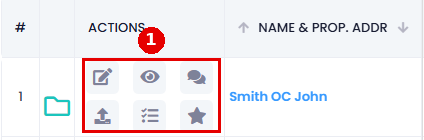
From left to right and top to bottom, the icons on each row are:
- Edit pencil (Open file): opens the loan file for editing.
- Eye (View file): opens the file in view-only mode.
- Upload document: upload documents to the file and put them in the right Required Docs.
- Add task: give a task to an employee or client, with a due date and reminder date.
- Star (Add as favorite): favorites show in Loan Origination > Favorite Files and are starred on the Dashboard's Most Recent list.
Files that have notes also show a speech-bubble icon. Hover it to see the file's latest 25 notes.
The quick view folder
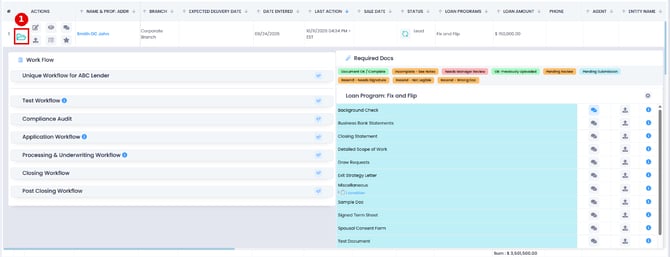
The green folder on the left of each row ("Click to Show/ Hide more info") opens a panel under the row, so you can check a file and do common tasks without opening it.
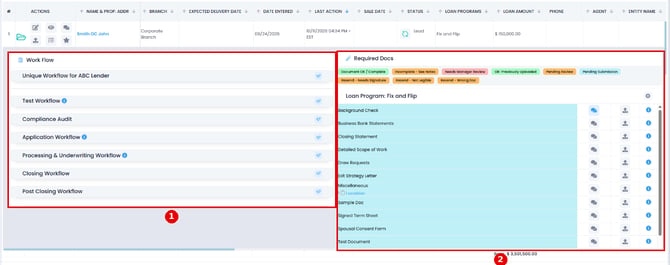
The panel has four parts. Work Flow and Required Docs are at the top, and Loan Info and More Actions are below them.
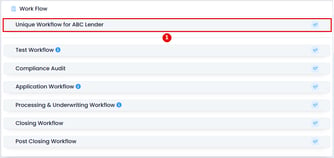
1. Work Flow
The workflow works like a checklist for the file. Use it to track action items, leave notes for your team inside a step, and set off automation rules (set up in Settings > Automation > Rules) when you tick a step. Learn more in Workflow Tab, Customizing Workflows and Workflow Automation.
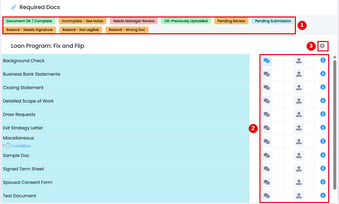
2. Required Docs
See which required documents are in and which are still pending, upload documents, read notes and descriptions for each document, and add a new required document for this file. Learn more in Required Docs & Conditions setup.
3. Loan Info
Hover the icon next to "Loan Info" to see key numbers such as the PITIA amount, taxes, disposable income and total expenses (plus details like loan number, balance, rate, P+I payment, HOA fees and SSN last four, when the file has them). The section shows the loan program, branch, loan officer, broker, borrower, property address and closing date. From here you can:
- Change the Primary Status and File Substatus: click the icon next to either one to open "Update File Status".
- Set a borrower call-back date with the calendar icon.
The loan program and branch are shown here but changed elsewhere: the program on the file itself, and the branch, loan officer and broker with the branch icon under More Actions.

4. More Actions
- Send an email campaign.
- Compose an email.
- Email the borrower their login instructions (if you have the Private Label option).
- Create a summary report of public and private notes, or of public notes only.
- Open the Action History.
- Update the workflow.
- Send the borrower a request for their free credit report.
- View or assign employees ("Click to View/Assign Employee(s)").
- Change the branch, broker or loan officer (branch icon, "Assign/View Loan Officer/Broker and Branch").
- Copy the file ("Click to copy this file").

Other pages in Loan Origination
My Assigned Files opens the Pipeline already filtered to files where you're an assigned employee, so you can focus on your own work.
Favorite Files shows the files you've starred with Add to favorites in the loan file header or on the pipeline row.
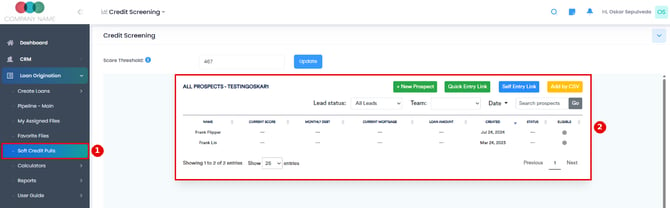
Soft Credit Pulls: please review the Terms of Service, Privacy Policy and FAQ before you turn on the Soft Credit Pull feature with Acqualify.